
The oldest conspiracy theory

“Conspiracy theories” are neither.

They’re not “theories,” for starters. Almost always, they are fiction. There’s nothing theoretical about them. They are deliberate, calculated falsehoods designed to promote lies.

They aren’t just “conspiracies,” either. A conspiracy, the dictionaries tell us, is “a secret plan by a group to do something unlawful or harmful.” Most often, there’s nothing secretive about “conspiracy theories.” In the social media era, they are right out in the open. They do big box office – more than the truth, some days.

The phrase “conspiracy theory” has been around since at least the Forties. An Austrian-British philosopher, Karl Popper, wrote a book called The Open Society and Its Enemies. In it, he used “conspiracy theory” to describe a simplistic explanation for complex events. Evil forces are usually seen as the authors of conspiracy theories, Popper wrote.

But it’s conspiracy theories that are themselves evil. They seek to blame someone or something for a catastrophic event: JFK’s assassination, 9/11, Covid-19.

In the past two years or so, harmful conspiracy theories are everywhere to be seen – on our computer screens, in the media, on the lips of those we thought we knew. And, overwhelmingly, they’ve been antisemitic.

The antisemitic conspiracy theories have been around for as long as Jews themselves: Jews secretly control everything. Jews cause plagues. Jews killed Christ. Jews cause wars. Jews have secret rituals. Jews conspire to acquire money and power. And so on, and so on. There are many.

Conspiracy theories about Jews have exploded since October 7, 2023, when Hamas and Gazans swept into Israel to murder, rape, kidnap and brutalize thousands of Jews. And what is truly astonishing is this: the antisemitic conspiracy theories were immediate, coordinated, and global.

For two or three days after October 7, the dominant conspiracy theories in the Muslim world were that Israel had killed Muslim children (it hadn’t), that a prisoner exchange was imminent (it wasn’t), and that Hamas was blameless (it, of course, wasn’t). Online, those were seen millions of times.

Then, English-language conspiracy theories started to circulate, and those were seen even more. Their main theme was denial: denial of the murders, denial of the rapes, denial of the atrocities. And: that Israel was behind it all, to get sympathy or justify the war that (predictably, justifiably) followed.

It was all lies. It was horrible and cruel. But it was developed and deployed brilliantly.

[To read more, subscribe here]


This is the moment – choose to oppose hate

That’s the moment.

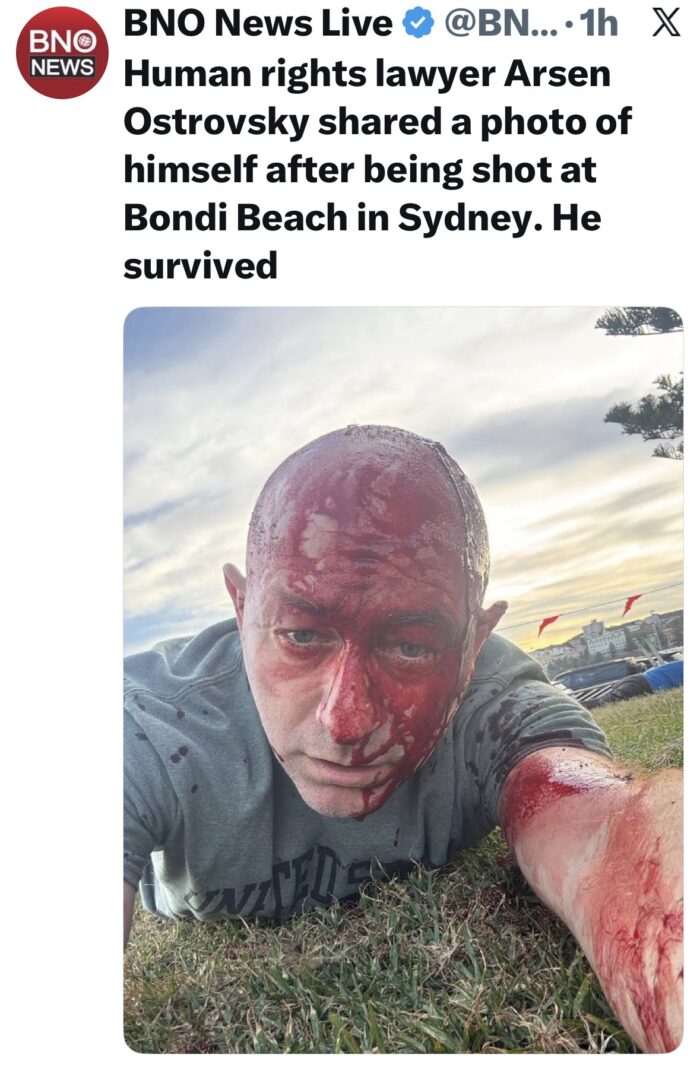
You wake up on Sunday morning, and pick up your phone, and there’s a photo of someone you know, covered in blood. His head, his face, his T-shirt: he’s covered in it.

He’s on the ground, on the grass, and there’s some cars behind him, and some banners fluttering in the sky.

The accompanying BNO News Live post reads: “Human rights lawyer Arsen Ostrovsky shared a photo of himself after being shot at Bondi Beach in Sydney. He survived”

That’s the moment.

There’s no period after the word “survived,” as if the author was interrupted. There’s no indication of why Arsen was shot, or who did it, or why. But, soon enough, your phone fills with the relevant details: two Muslim men, a father and son, have gone on a killing spree at a beach in Australia. Hunting for Jews.

Arsen was on the beach with his family. To celebrate the start of Chanukah, which is an eight-day Jewish festival, and which marks the triumph of light over darkness. And, now, he’s staring back at you on your phone, covered in blood from a bullet wound to his head.

And that’s the moment, folks, when the camera lens swings back onto you. What do you do? How do you react?

If you are like a lot of other people, these days, you just keep scrolling. A weather report and some sports scores later, you’ve perhaps already forgotten about Arsen Ostrovsky and the 15 people – a rabbi, a Holocaust survivor, children – who were slaughtered on Bondi Beach.

Me, I couldn’t stop thinking about Arsen, who I know. I’ve talked to him, I’ve interviewed him. He helped me out on the book I’ve written. He’s this smart, thoughtful, kind-hearted guy. He talked to me about his family, about moving from Ukraine to Australia when he was a kid. To get away from antisemitism. He talked about living in Israel for a while, and then returning to Australia to start a new job. To oppose the haters.

[To read more, subscribe here]


Yes, Daisy is growing again! Help wanted!

If you’ve got great research, writing and thinking skills, Daisy Group wants you! We’re hiring – so please send your CV and (persuasive) cover letter to our VP Trish  at: Trish AT Daisy group DOT ca – and don’t delay!


Arsen and the rest of us

I know Arsen. He helped me enormously with my new book The Hidden Hand. I am shocked, truly, by what happened in Australia but grateful he survived. God bless him and everyone dealing with this horror this morning

I said months ago that people were going to get killed – and they have been, in Washington, Boulder and now Bondi Beach.

For you, you have to ask yourself: have I condemned the Jew hatred that has taken innocent lives? Have I been indifferent to the suffering that Jews now experience, everywhere? Have I done something, anything, to stop this madness?

For me, I have been invited to celebrate the first day of Chanukah with Jewish friends at the synagogue in Belleville. And I am going to stand with them, and support them, and help protect them. Always.


The triumph of light over darkness

The triumph of light over darkness.

That’s all it means, really: perseverance, faith. It’s a characteristic of just about every religion, when you think of it. Hope. Hope for something better.

Is a symbol of hope – of faith, of perseverance – somehow objectionable? Is it wrong, to want that? It is for a bunch of people who run a Toronto-area building, allegedly.

Because…it’s a Jewish symbol?

Here’s the sad story: a couple years ago, a woman who we have agreed not to name asked her condo building’s board if it would be okay to put up a small menorah in the lobby.

A menorah is basically a little candelabra that holds, you know, nine candles. In public places, the menorah don’t usually have real candles – just fire-safe representations of candles.

There was a Christmas tree in the lobby. The woman asked if there could be a menorah, too.

The condo board said no.

Here’s the thing: Chanukah, which starts today, celebrates the Maccabees defiance – and triumph over – those who were trying to silence Jews. Trying to erase them. Which is what the condo board seemed to be doing to the woman who asked for a menorah, too.

“Feeling like my identity as a Jewish woman was unwelcome in the building where I live – was devastating,” she said.

So she went and put up a menorah anyway. Not long after, the condo board told her to remove it. They had issued a “directive,” allegedly. But they wouldn’t show the directive to her.

That was 2023. In 2024, the condo board banned all “religious” displays. This year, they changed course yet again – a Christmas tree would be permitted, because it was “cultural.” A menorah wouldn’t be, because it was “religious.”

For the woman, that was the final straw.

Says she: “We’re living in a time of rising antisemitism – the worst since the Holocaust – and moments like this remind me why it’s so important to speak up. Chanukah is about pride and perseverance, and I refuse to let my identity be pushed aside. In Canada, in 2025, equal recognition of who we are should be a given – not something you have to fight for.

“This is not about pitting cultures against one another but embracing an approach where all identities are included and respected.”

So she’s taking the condo board to court – the Human Rights Tribunal of Ontario, to be precise. And CIJA, The Centre for Israel and Jewish Affairs, is helping her.

They’ve made a human rights complaint – arguing that choosing one religion’s symbol (a Christmas tree) over another religion’s symbol (a menorah) is “direct discrimination.” That kind of discrimination disproportionately hurts Jews, obviously. And, CIJA says, the condo board “failed to provide accommodation, transparency, or a legitimate justification for their decision.”

Says Richard Marceau, Senior Vice President, at CIJA: “It’s 2025. No one should have to fight for equal recognition of their religious and cultural identity in their own home.” Well said.

We’re not giving the address of the building, to protect the identities of the people who live there. CIJA and the applicant agree with that.

But the applicant still insists on a few things: if she prevails, she wants the condo board to get some training about how to handle situations like this. She wants a new policy for holiday displays. She wants a small payment of damages.

And, of course, she wants a menorah in the lobby.

Where it belongs.


The evil within

Attacks on Jews at Toronto’s Metropolitan University. Students at a California school forming a swastika with their bodies on a football field, alongside a quote from Adolf Hitler. A far-Right creep going on Piers Morgan to say that “Hitler was cool.” Those are the recent examples.

And many, many other instances of Jew hate in the past two years, too many to list: antisemitic encampments at universities, mobs blockading streets and predominantly-Jewish neighborhoods, vicious attacks on Jews and Jewish institutions. Sometimes – in places like Washington, D.C. or Boulder, Colorado – even murder.

With all of those incidents, wherever they are happening, there is one common element: the perpetrators.

The perpetrators – the haters – are young people.

Antisemitism remains anathema to those in their forties and older. But to so-called Gen Z (ages 18 or so to 25) and Millennials (ages 25 to 40 or so), antisemitism is all the rage, in these dark days. From Holocaust denial to antisemitic blood libels to support for monsters like Hamas: young people, across Western democracy, are the demographic that have become most susceptible to the homily of hate.

It’s well-known that Jew hatred has lately been a defining characteristic of the Left. Young people with self-identified progressive ideals have shown they are far too willing to adopt antisemitic tropes and themes.

But now, a new report by a respected American conservative think tank suggests the problem is growing on the Right, too. The report, by the Manhattan Institute for Policy Research, was released earlier this month. And it paints a disturbing picture about the attitudes and beliefs of young people across the ideological spectrum.

The main focus of the report is the U.S. Republican coalition, which has been resolutely pro-Israel since the Ronald Reagan era. The Manhattan Institute canvassed the opinions of what they called Core Republicans, the majority made up of those who tend to be older and longstanding party members/supporters.

Among what they called “New Entrant Republicans,” however, ominous trends were seen. “The survey’s first major finding is that the overwhelming majority of the current GOP reject racism, antisemitism, and conspiratorial thinking in politics,” the Institute noted.

But nearly 20 per cent were what they called “anti-Jewish Republicans.” Said the report: “Anti-Jewish Republicans are typically younger, disproportionately male, more likely to be college-educated, and significantly more likely to be New Entrant Republicans.”

The shocking trend was not seen among Republicans alone. “The survey finds slightly higher levels of anti-Jewish sentiment among Democrats—20 per cent, compared to 17 per cent among Republicans,” the report’s authors noted. “[Younger Republicans are] more likely to express tolerance for racist or antisemitic speech, more likely to support political violence, [and be] more conspiratorial.”

And young Republicans are big, big believers in conspiracies. The topline conspiracy theories – NASA faked the moon landing, the Holocaust did not happen, 9/11 was an inside job, childhood vaccines cause autism, and so on – were enthusiastically embraced by younger GOP members. A third of them believe most or even all of the conspiracies.

Meanwhile, older Republicans strongly oppose antisemitism, by a factor of nearly two to one. They also feel that antisemites should not be welcomed into their ranks “under any circumstances.”

But, again, the younger cohort are far more likely to have racist (31 per cent) or antisemitic (25 per cent) views.

Said the Institute: “These [Republicans] are also significantly more likely to believe multiple conspiracy theories and to support political violence. Consistent with their higher likelihood of falling into the anti-Jewish Republican category, roughly one in three self-identify as either racist or antisemitic.”

And: “Younger and newer members of the GOP coalition contain a frustrated, alienated subset that is often hostile toward institutions and norms.”

And, as other polls in the U.S., Canada and Europe have shown with youthful progressives, young people on the Right are far more willing to justify the use of violence in politics – which, of course, is the literal definition of terrorism: using violence to achieve a political goal. Fully 54 per cent of young Republicans believe violence is justified in politics, says the report.

Concluded the Manhattan Institute: “Support for political violence is also high among those who believe many conspiracy theories and among those who tolerate openly racist or antisemitic individuals.”

“And age,” they wrote, “is one of the strongest predictors.”